
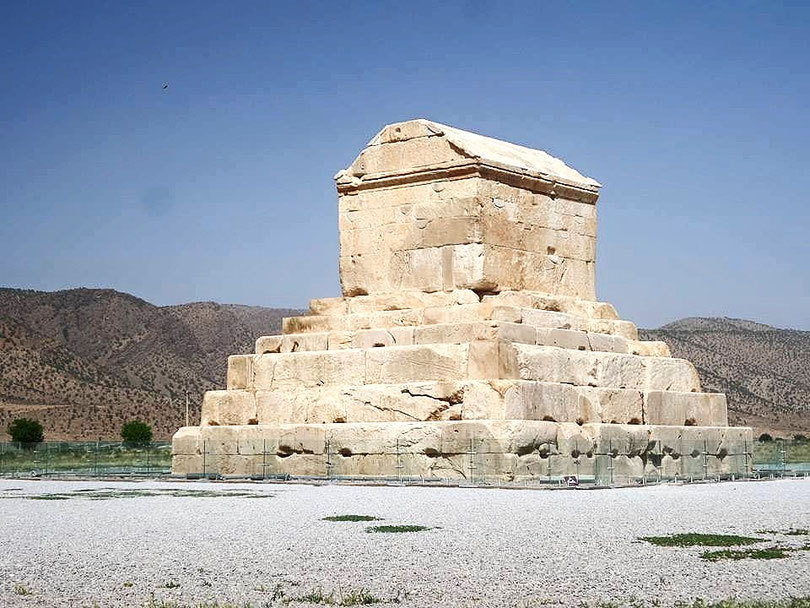
The road eventually delivers us to the silent plains of Pasargadae and the tomb of Cyrus the Great. Or, as any local would pointedly correct you, Kurush. In Iran, "Cyrus" is a Hellenized ghost; to the people here, he remains Kurush—a name synonymous with the sun. Shrouded in the mythos of a royal heir raised by shepherds to escape a death sentence, Kurush’s ascent was more than a conquest; it was a social revolution. Upon founding the Achaemenid Empire, his first act was to dismantle the institution of slavery, establishing a system of compensated labor that was millennia ahead of its time.
If you ever find yourself strolling through the galleries of the British Museum in London, you will surely notice the Cyrus Cylinder. It does not dazzle with the brilliance of golden treasures; it is a small, cracked clay artifact that is hard to call a "jewel" in the traditional sense.
Discovered in the ruins of Babylon in 1879, the Cylinder describes the conquest of the city by Cyrus II in 539 BCE. However, it praises Cyrus not as a conqueror, but as a liberator chosen by the Babylonian god Marduk. The text recounts how Cyrus repatriated enslaved peoples, rebuilt their temples, and guaranteed freedom of worship.
The value of the cylinder lies not in its appearance, but in its ideas. Cyrus’s policy of tolerance laid the foundation for the belief that people of different traditions and languages could live together in peace. Some historians call this artifact the world’s first declaration of human rights.
The domain of Cyrus the Great became the first true empire in history, built upon the powerful doctrine etched into this humble piece of clay.
The ancient Greek historian Plutarch mentions an inscription found on the ruler’s tomb: "O man, whoever you are and wherever you come from, for I know you will come: I am Cyrus, who won the Persians their empire. Do not, therefore, begrudge me this little earth that covers my body."
Sadly, the sepulcher was plundered even before the arrival of Alexander the Great. Upon seeing the ransacked chamber, the young conqueror ordered the culprits found and punished, paying his final respects to the great Persian King of Kings.
THE LIVING GARDEN
The Persian reverence for the garden (pardis) is not merely aesthetic; it is ancestral. It is said that Kurush himself refused to dine until he had labored in the earth, planting flora from the far reaches of his empire. The black mulberry, now a staple across Europe, traces its lineage back to these very soils. In Shiraz, the "family tree" is a literal concept; mulberries grace almost every courtyard, their fruit a seasonal communal feast.
As dawn breaks over the city of poets, the sun crests the Qur'an Gate, and the eastern breeze carries the heavy, velvet scent of roses. Shiraz is a city of over three hundred varieties, a place where the landscape is an olfactory map. Walking toward the Hafez Mausoleum, the pavement is stained dark by fallen mulberries—nature’s own ink.
In a quiet park, we encountered two women and a child harvesting the fruit. They offered a handful with a grace that felt like a benediction. "Youth is a fleeting guest," one remarked, her blue headscarf catching the morning light. "Nurture your love, for it is the only thing that remains." It was a quintessentially Persian moment—a blend of hospitality and profound, unprompted philosophy.
CONTRASTS OF THE MODERN SOUL
At a local eatery, the atmosphere is defined by the rhythm of the takht (traditional daybed) and the scent of woodsmoke. In a white clay oven, an artisan baker—clothed in a pristine white uniform—moves with the fluidity of a dancer. Watching him stretch and slap the dough against the kiln walls, one realizes that in Iran, craft is a lineage. This is an inherited geometry, passed from grandfather to grandson, a testament to the dignity of manual labor.
Yet, the kitchen conversation with a group of local women reveals a different tension. They are curious about the outside world, specifically the allure of Ukrainian women in the eyes of Iranian men. The discourse is a complex web of geopolitics, the prestige of international marriage, and "visa advantages."
The modern Shirazi aesthetic is one of striking contrasts. Amidst the ancient architecture, one sees the prevalence of contemporary beauty standards: meticulously sculpted features and a penchant for aesthetic surgery. For many young women, a "successful" marriage remains the primary social currency. It is a poignant juxtaposition—a culture that pioneered human rights now navigating the narrow corridors of modern societal expectations.
A LEGACY OF JOY
Prior to the 1979 Revolution, Shiraz was the epicenter of global viticulture, its sun-drenched slopes producing some of the world’s most celebrated grapes. Today, the harvest is destined for juice, yet the spirit of the city remains stubbornly hedonistic. Behind the high walls of private villas, the tradition of the "city of secrets and song" lives on. Parties are frequent, and the hospitality remains radical; whether a lifelong friend or a passing traveler, every guest is treated as a long-awaited homecoming.
In Shiraz, the past is not a ruin; it is a conversation that continues over tea, in the shade of a mulberry tree, and in the enduring kindness of strangers.

Write a comment