

If you had seen Tehran fifty years ago, you would hardly recognize it. Then again, even many Tehranis struggle to recognize their city today.

Once, Tehran was a vast garden. High mud-brick walls divided it into squares, concealing orchards, water channels, and peaceful courtyards. From the north, cool air descended from the Alborz Mountains, bringing life to the villages clinging to their slopes. Today, those villages have become the neighborhoods of northern Tehran. To the south lay Rey, one of the oldest cities in Iran, now absorbed into the sprawling metropolis as one of its working-class districts.
Modern Tehran is a loud giant. It greets travelers with choking smog in the winter, grabs them by the throat with hot air in the summer, and forces them to quicken their pace. It tests everyone who arrives here, demanding an honest answer: do you love it or do you hate it?

And if, somehow, you begin to love this city, it reveals its secrets. It guides you through narrow alleyways of old neighborhoods, shows you houses with carved wooden doors, leads you into gardens shaded by ancient trees, blooms with roses in nearby parks, and fills your days with golden sunlight. That is the Tehran I remember.
One spring morning, as I stepped outside my home, I found a note attached to the door. A stranger was offering to sell his kidney and had left a phone number. In Tehran, this was not nearly as unusual as it sounds. Life here has always pulsed on the edge of tragedy, absurdity, and humor.
Only later did I realize that my own choice—to love or to hate this city—had changed the way I saw the world. Tehran and I seemed to reach an unspoken agreement: I would not try to enter its soul, and it would not try to enter mine. Somehow, we became friends.

In this part of the world lives a people shaped by a profound spiritual tradition. Islam intertwines with the legacy of ancient Zoroastrianism, while the present remains in constant conversation with the past. Like everywhere else on our astonishingly beautiful planet, people here struggle with their weaknesses, make mistakes, learn their lessons, and begin again.
Their ancestors left them a priceless inheritance—thousands of parables, legends, poems, and words of wisdom. Yet history has not always been kind to Persia. Following the Arab conquest, countless libraries were destroyed. Books were burned to heat bathhouses, and with them disappeared centuries of accumulated knowledge. It is difficult to imagine how much was lost. The people whom travelers once called fire worshippers possessed a profound understanding of nature, humanity, and the world around them.
One day, while running across one of Tehran’s wide multi-lane roads, I had an unexpected revelation. Traffic lights are often treated more as suggestions than rules, and traffic police sometimes seem to be little more than part of the scenery. Standing amid the chaos, I suddenly understood why so many people here have such strong faith in God. In traffic like this, only a higher power can guarantee your safe arrival on the other side of the street.
My favorite part of Tehran was Darakeh.

To an outsider, it is simply another neighborhood on the map. To me, it was an entire world. The scent of freshly brewed tea beside a mountain stream, the sound of water rushing over stones, the sweet-and-sour taste of lavashak, a glass of pomegranate juice, and early morning walks beneath the slopes of the Alborz Mountains.
According to one explanation, the name Darakeh comes from the Persian word darreh, meaning “valley.” It is an appropriate name, as the village lies in a narrow mountain gorge where a cold river flows between the peaks. Another theory connects the name to dargeh, a type of traditional footwear once used for walking through snowy mountain terrain.
For centuries, Darakeh served as a summer retreat for Tehran’s residents and Persian nobility. When the city below suffocated in the summer heat, cool air lingered here. During the Qajar and Pahlavi eras, wealthy families built summer residences among its gardens.
In the second half of the twentieth century, Tehran gradually absorbed the surrounding villages, yet Darakeh managed to preserve its character. Even today, its narrow garden lanes, traditional teahouses, old restaurants, and the atmosphere of historic Shemiran survive.
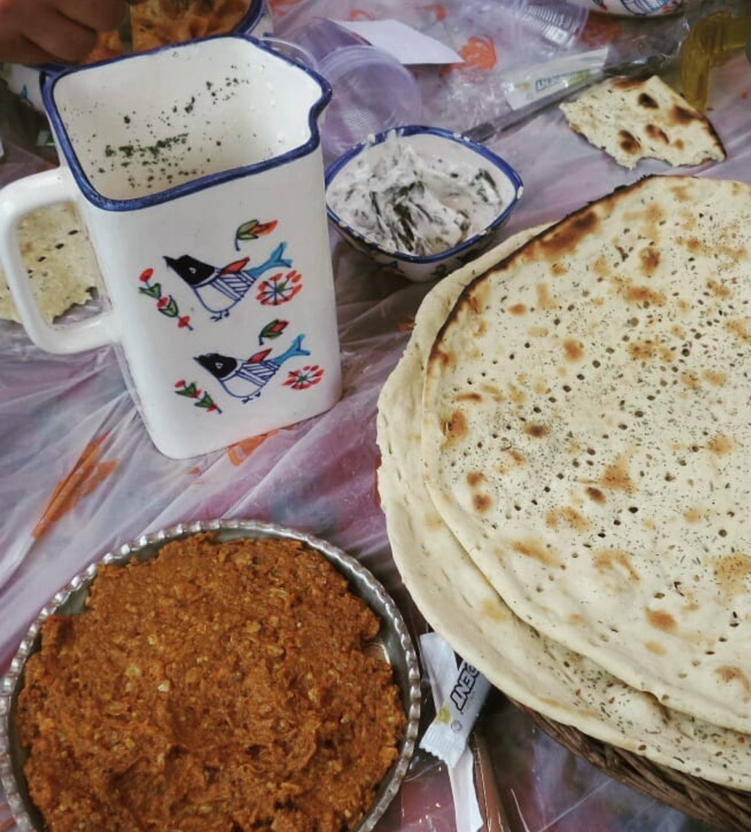
Darakeh is now one of the main gateways to the hiking trails of the Alborz Mountains. From here, paths climb toward Mount Tochal. Along the river stand dozens of teahouses and restaurants serving fragrant tea, dizi, kebabs, and traditional snacks.
Together with neighboring Evin, Darakeh forms the historic Evin–Darakeh Valley, once famous for its gardens, springs, and fruit orchards. It is no surprise that older Tehranis still refer to the area as the green lungs of the city.
An important part of this story belongs to the chenar trees.
Northern Tehran—Shemiran, Darband, and Darakeh—was once lined with avenues of these magnificent trees. Even today, ancient chenars remain an essential part of the city’s memory.
The chenar, or Oriental plane tree, is one of Iran’s most revered trees. For thousands of years it has grown in Persian gardens, along caravan routes, and in public squares. Some of these trees are more than a thousand years old.
For Persians, the chenar symbolizes longevity, wisdom, and resilience. It represents the connection between generations and the endurance of memory through time. In traditional Persian gardens, plane trees were planted beside streams and canals as symbols of fertility, prosperity, and harmony between humanity and nature.

In the poetry of Hafez, Saadi, and Rumi, trees often represent the human soul reaching toward the light. The chenar, in particular, embodies nobility, inner strength, and spiritual endurance.
Beneath its broad canopy, generations gathered. Travelers rested in its shade, communities held meetings, weddings were celebrated, and stories were shared.
There is a Persian saying: “The shade of an old chenar is a blessing for the traveler.”
Perhaps that is why, when I remember Tehran, I do not see the smog or the endless traffic jams. I see the mountain river of Darakeh, sunlight filtering through the leaves of an ancient chenar tree, and a city that once taught me to look at the world with a wider perspective.


Write a comment